
WHY IS THE GREAT MIGRATION BETWEEN KENYA AND TANZANIA ONE OF THE WORLD’S MOST MUST SEE WILDLIFE SPECTACLES?
The Great Migration between Kenya and Tanzania is more than just a wildlife event it’s a living drama of survival, nature, and scale. It earns its status as a must-see spectacle for several reasons.
- Massive scale and sheer numbers
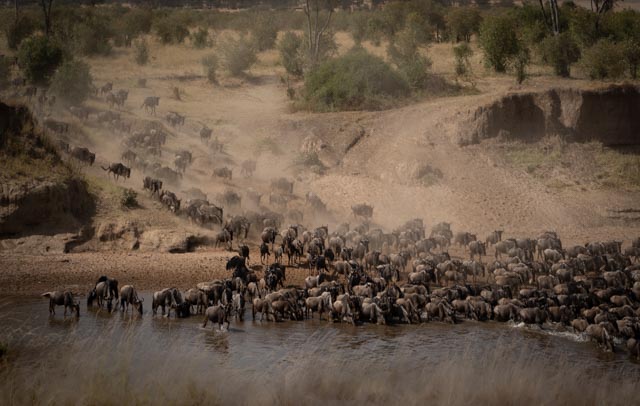
Every year, over 1.5 million wildebeest, along with hundreds of thousands of zebras and gazelles, traverse the Serengeti-Mara ecosystem. These enormous herds create a moving sea of life that is hard to compare with any other migration on Earth. The scale alone makes it awe-inspiring.
- Dramatic river crossings & predator action
One of the most heart-pounding moments occurs when the herds must cross rivers like the Mara or Grumeti. Crocodiles lurk beneath, currents are strong, and the wildebeest hesitate before plunging in. Meanwhile lions, cheetahs, leopards, and hyenas follow closely, ready to exploit any weakness. These dangerous crossings and predator-prey interactions make for unforgettable wildlife viewing.
- The rhythm of nature: births, movement, survival
The migration isn’t just about movement; there is new life, and there is risk. During the calving season (roughly December-March in the southern Serengeti / Ndutu region), thousands of calves are born each day. These newborns are vulnerable, which draws predators and adds emotional intensity to the experience. The cycle of chasing fresh grazing, avoiding droughts, and migrating yet again underscores nature’s delicate balance.
- Exceptional wildlife viewing with variety
Beyond the wildebeest and zebras, the migration brings out large predator populations, large-herd dynamics, and huge open plains landscapes. Birdlife is abundant, and scenery from the sweeping Serengeti plains to the rolling grasslands of Maasai Mara changes with seasons.
- Cultural & conservation importance
The Great Migration supports many communities through tourism. Park fees, safari lodges, guides all contribute to local economies and to wildlife conservation. Moreover, the migration’s health is a barometer for environmental stability rainfall patterns, grass growth, water availability. Threats like climate change, habitat fragmentation, and human encroachment can disturb this rhythm. So, seeing the migration also helps raise awareness about preserving ecosystems.
TIMING AND ACCESSIBILITY FOR VISITORS
For travelers, there are predictable windows when the migration’s most dramatic moments happen especially river crossings (≈ July to September) in Maasai Mara / Northern Serengeti, and the calving season earlier in the year. Although there is variation due to rain, these windows allow planning. Plus, there are famous camps, private conservancies, and excellent safari operators in both Kenya and Tanzania geared to help visitors experience this spectacle with relatively good infrastructure.